
Land and due diligence
Digital Cadastre of Greece 2026: What Has Changed for Foreign Land Buyers
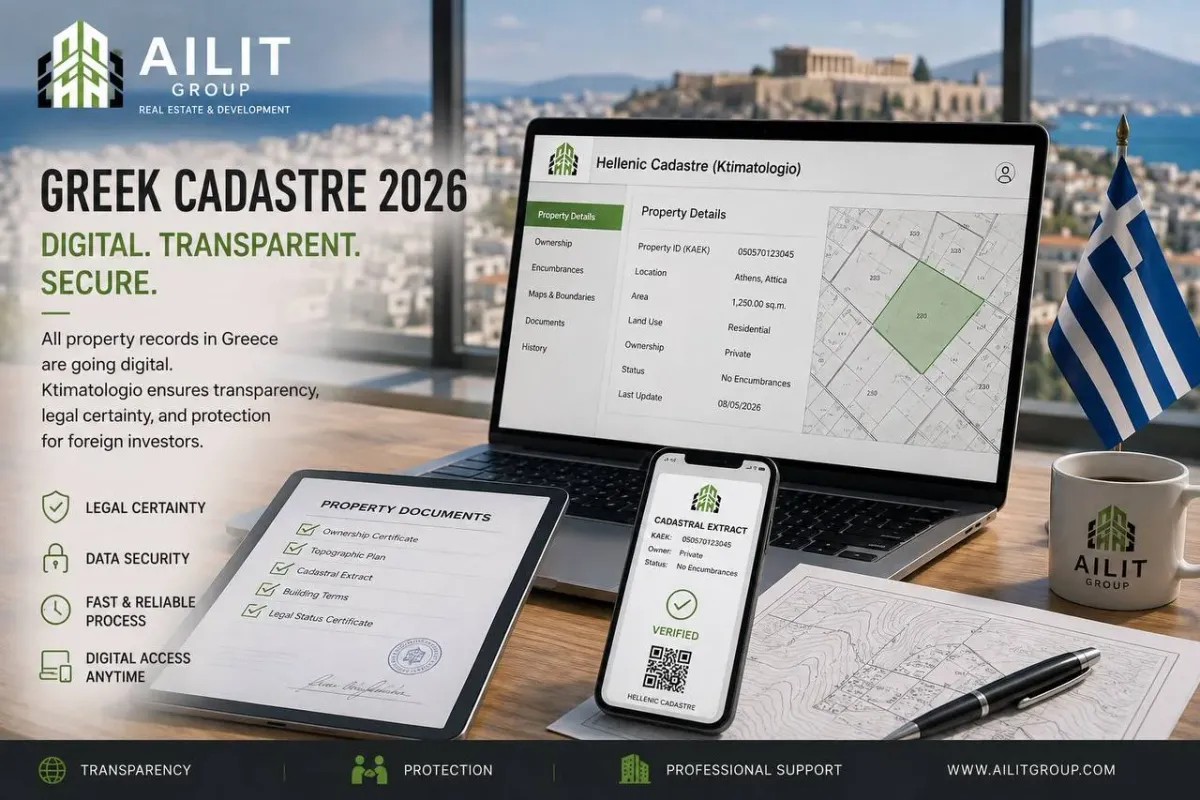
In 2026, Greece is completing one of its largest real estate digitization projects—the transition from fragmented paper mortgage registry archives to the unified Hellenic Cadastre (Ktimatologio) system. By the end of the year, all properties in the country are expected to receive a KAEK cadastral number, and around 600 million pages of old registries are being transferred into an official digital archive.
For a foreign investor, this means a more transparent plot verification, fast access to information, and a reduced risk of purchasing land with non-obvious legal issues. However, an electronic entry alone does not replace a comprehensive legal audit.
What Ktimatologio Shows
The cadastral system records the following data:
- Location of the plot, its boundaries, and area;
- Cadastral number KAEK;
- Registered owner and type of ownership right;
- Mortgages, liens, third-party claims, court disputes, and other registered encumbrances.
A lawyer can retrieve the cadastral sheet, plot plan, and required certificates remotely. The electronic property transfer file consolidates transaction documents and accelerates title registration after signing the notary contract.
Before making a deposit, it is important to independently verify the plot before buying in Greece rather than relying solely on an extract provided by the seller.
Why a Double Check Is Necessary
A reliable check is conducted on two levels.
First Level — Current Ktimatologio Record
A lawyer cross-references the owner, KAEK, area, boundaries, ownership share, and registered encumbrances with the seller’s deed and topographic plan.
Second Level — Old Mortgage Registry Archives
Prior deeds, inheritance, gifts, mortgages, liens, claims, and the chain of title transition are verified. This is especially important for land that has been passed down within a family for decades, acquired through adverse possession, or shows discrepancies between old documents and the new cadastral record.
Digitization of old archives makes such checks faster, but it does not eliminate the need to analyze the title history. An initial cadastral entry may contain an error, and a dispute over a boundary or ownership share might still be in the process of correction.
What Risks the System Protects Investors From
A double check helps identify:
- A seller who owns only a partial share of the plot;
- An active mortgage or lien;
- Claims from an heir or neighbor;
- Discrepancies in area and boundaries;
- An incorrect initial record;
- The absence of an unbroken chain of title documents.
At the same time, a legally clean title does not guarantee building permission. An engineer separately verifies urban planning zones, building coefficient, lawful access, forest maps, coastline restrictions, as well as archaeological and environmental constraints. Answers to key foreign buyer questions are collected in the AILIT Group FAQ section.
What a Buyer Must Do Before Making a Deposit
Before signing a preliminary agreement, it is necessary to:
- Obtain a written legal opinion from a lawyer regarding title ownership and archive history.
- Obtain an engineer’s assessment regarding boundaries and buildability.
- Ensure that all discrepancies are resolved prior to paying a non-refundable deposit.
AILIT Group organizes land verification, building potential calculations, architectural design, and subsequent construction of real estate in Greece. The digital cadastre makes the market more transparent, but real investor protection is ensured only by combining electronic data, archival verification, and technical analysis of the plot.
Article reviewed by expert — AAA class developer Alexey Fatuev.